product.details.print


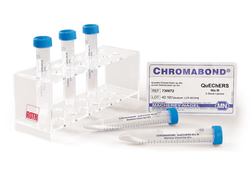
QuEChERS Extraction Mix ROTI®XBond Original unbuffered, 50 stuks, 15 ml tubes
71,25 €/VE Campaign price!
Excl. btw | 50 stuks Per VE
Bestelnr. 24LN.1
Geschikt voor / Toebehoren
Productdetails
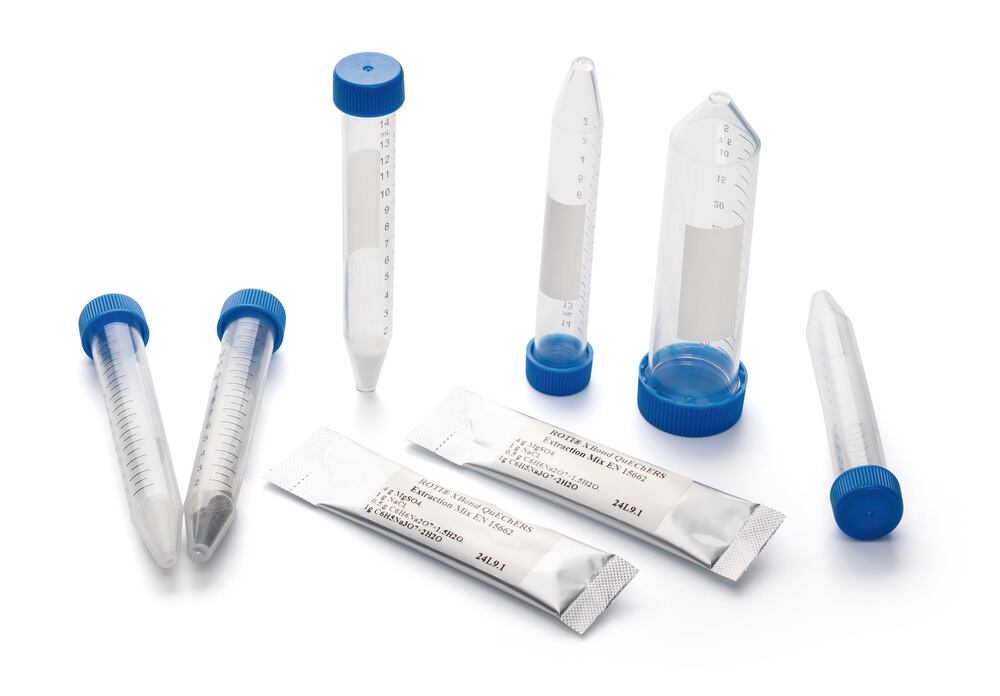
QuEChERS Extraction Mix ROTI®XBond Original unbuffered
For analysis of mycotoxins in food and feed (e.g. Wheat flour, rye flour) and analysis of PFAS in food (e.g. milk, quark, bread, brussels sprouts, spinach, egg).
| Naam | unbuffered |
| Uitvoering | 15 ml tubes |
| Methode | Original |
| Samenstelling |
4 g MgSO4 1 g NaCl |
| Verpakking | 50 x 6.5 g in 15 ml tubes |
| Aanbevolen toepassing(en) |
Forensic and drug samples Food samples Pesticides |
- Tussentotaal: 0.00
| Bestelnr. | VE | Uitvoering | Methode | Prijs | Hoeveelheid | |
|---|---|---|---|---|---|---|
| 24LN.1 | 50 stuks | 15 ml tubes | Original |
89,15 €
71,25 € |
|
|
| 24LP.1 | 50 stuks | 50 ml tubes | Original |
141,40 €
113,05 € |
|
|
| 24LT.1 | 50 stuks | Pouches and empty 50 ml tubes | Original |
138,70 €
110,90 € |
|
|
| 24LX.1 | 50 stuks | Pouches | Original |
56,90 €
45,45 € |
|
|
| 24LY.1 | 1 kg | Premixed bottle (equivalent to ca. 200 extractions) | Original |
66,55 €
53,20 € |
|
|
|
Op voorraad
Beschikbaar (let op levertijd)
In bestelling
Niet meer verkrijgbaar
Leveringsdatum onbekend
|
||||||


- Tussentotaal: 0.00
Downloads / MSDS
Algemene informatie
U vindt nog meer aantrekkelijke aanbiedingen om uw chromatografielaboratorium te vervolledigen op onze Chromatografie pagina!
For pesticide residue analysis in food
The QuEChERS (Quick, Easy, Cheap, Efficient, Rugged, Safe; "Catchers") method has achieved a leading position for the determination of pesticide residues in food by GC-MS or LC-MS within a few years of its development.
This method was developed using an extraction method for pesticides in fruit and vegetables coupled with a clean-up method that removes sugars, lipids, organic acids, sterols, proteins, pigments and excess water. This technique offers a user-friendly alternative to conventional liquid-liquid and solid phase extractions.
The process involves two simple steps. First, an extraction of the homogenised samples takes place, which are split with an organic solvent and a salt solution. The supernatant is then further extracted and purified using dispersive solid phase extraction (dSPE).
This allows rapid and cost-effective processing of heavily matrix-loaded samples. In order to optimise the extraction of pH-dependent compounds, to minimise the decomposition of sensitive substances and to cover a broad matrix spectrum, various modifications of the QuEChERS method have been developed.
- Unbuffered original method
- European method EN 15662
- AOAC Official 2007.01 Method
Carl ROTH offers QuEChERS extraction and dSPE products in a variety of standard sizes and formats, making the QuEChERS method even easier to use.
Extraction
The choice between the original unbuffered method salts and buffered method salts should be based on the expected pH of the final extract and the pH sensitivity of the target analytes. The unbuffered original method is well suited for most analytes. When using unbuffered salts, the pH of the final extract is largely determined by the pH of the sample. However, if critical target analytes are unstable at certain pH values, a buffered method that maintains the required pH will provide more accurate results for pH-sensitive pesticides.
For extraction, the European Standard EN 15662 recommends a citrate extraction mix, while the AOAC Standard 2007.1 uses an acetate extraction mix.
Clean up via dSPE
The key to optimising QuEChERS purification lies in the selection of absorbents that effectively remove different types of interferences in different samples. The aim is to achieve efficient but not excessive purification so that interferences are removed and the target analytes remain in the extract.
During purification, the diamino phase (PSA) removes sugars and organic acids, for example. Magnesium sulphate is used to remove water, while C18 ec removes non-polar interfering substances such as fats and the carbon phase removes pigments, sterols and other non-polar substances.
The type and relative amount of matrix components that need to be removed from the extracts prior to analysis will help you select the appropriate dSPE products.
Adsorbents and what their use
| MgSO4 | Removes excess of water |
| NaCl | For phase separation |
| Silica Gel 60 Diamino (PSA) (Primary Secondary Amine) |
Removes organic and fatty acids, sugars and polar pigments (e.g. anthocyanes) |
| Silica Gel 60 C18 ec (reversed phase modified silica) |
Traps nonpolar compounds (e.g. lipids) |
| Carbon (GCB) (Activated Charcoal / Graphitized Carbon Black) |
Removes non polar pigments and sterols (please note: planar pesticides are also removed) |