product.details.print


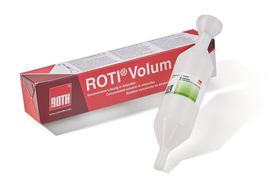
EDTA disodium salt solution, 1 l, plastic
Molar mass (M) 372,24 g/mol
Density (D) 1 g/cm³
Boiling point (bp) 100 °C
WGK 1
CAS No. 6381-92-6
EG-Nr. 205-358-3
36,05 €/VE
Excl. btw | 1 l Per VE
Bestelnr. CN34.1
Productdetails
EDTA disodium salt solution 0,01 mol/l - 0,01 N, volumetric standard solution
| Schroefdraad | DIN 45 |
| Concentratie, omgerekend | ~0,37 % |
- Tussentotaal: 0.00
| Bestelnr. | VE | Verp. | Prijs | Hoeveelheid | |
|---|---|---|---|---|---|
| CN34.1 | 1 l | plastic |
36,05 € |
|
|
| CN34.2 | 5 l | ROTI®CUBE |
112,90 € |
|
|
| CN34.3 | 10 l | ROTI®CUBE |
198,90 € |
|
|
|
Op voorraad
Beschikbaar (let op levertijd)
In bestelling
Niet meer verkrijgbaar
Leveringsdatum onbekend
|
|||||
- Tussentotaal: 0.00
Downloads / MSDS
Algemene informatie
A volumetric standard solution is a solution containing a precisely known concentration of a substance. The concentration of a volumetric standard solution is determined using a primary standard, which is accurately weighed and dissolved to make a specific volume. Volumetric standard solutions are made using reagent-grade (p.a.) substances as source materials.
The advantages of this over making them yourself are:
- Manufactured and tested using modern manufacturing and analytical methods
- Ready-to-use solutions
- High accuracy for precise analyses
- Application of NIST-certified reference substances for checking
- Connection to standard titrators is possible
Titer details: Many of our standard solutions also provide the corresponding titer details in the specification and on the certificate of analysis, in addition to the amount of substance concentrations. If no information is provided, the maximum percentage deviation of the titre corresponds to the specified range of variation in the concentration of the substance. Example: Amount of substance concentration 0,1 mol/l ±0,2 %
It follows that the titer is 1 ±0,2 %, i.e. 0,998-1,002. We recommend the regular checking of the titer prior to application for opened products.
Determination of Water Hardness
Water contains a whole host of salts and other compounds in addition to the gases dissolved in it (oxygen, nitrogen, carbon dioxide). Its most important constituents are magnesium and calcium in the form of their chlorides, sulphates and bicarbonates. These dissolved salts are known as hardeners. The bicarbonates precipitate in the heat (during boiling) as carbonates and are known as carbonate hardness or temporary hardness. The sulphate and chloride compounds are known as permanent hardness or non-carbonate hardness. Total hardness describes the concentration of alkaline earth metal ions in water.
The unit of measurement for water hardness used to be 1 °dH (German degrees of hardness), which corresponds to 10,00 mg CaO or 7,19 mg MgO in one litre of water. Today we use millimoles per litre (mmol/l), whereby 1 °dH corresponds to 0,18 mmol/l of earth metal ions and 1 mmol/l corresponds to 5,6 °dH.
Analysecertificaten
Type analysis
| Amount-of-substance conc. (20 °C) | 0,01 mol/l ±0,5 % |
| Titer | 0,995-1,005 |